

Opposition Governors Challenge Party Loyalty Amid Presidential Campaign Alignments
The alignment of some opposition governors with President Bola Tinubu's re-election campaign raises critical questions about party loyalty and the unity of opposition forces as Nigeria approaches the 2027 general elections. Key figures like Wike, Soludo, and Adeleke are at the center of a political storm that could reshape the landscape of Nigerian politics.
The Abuja Times
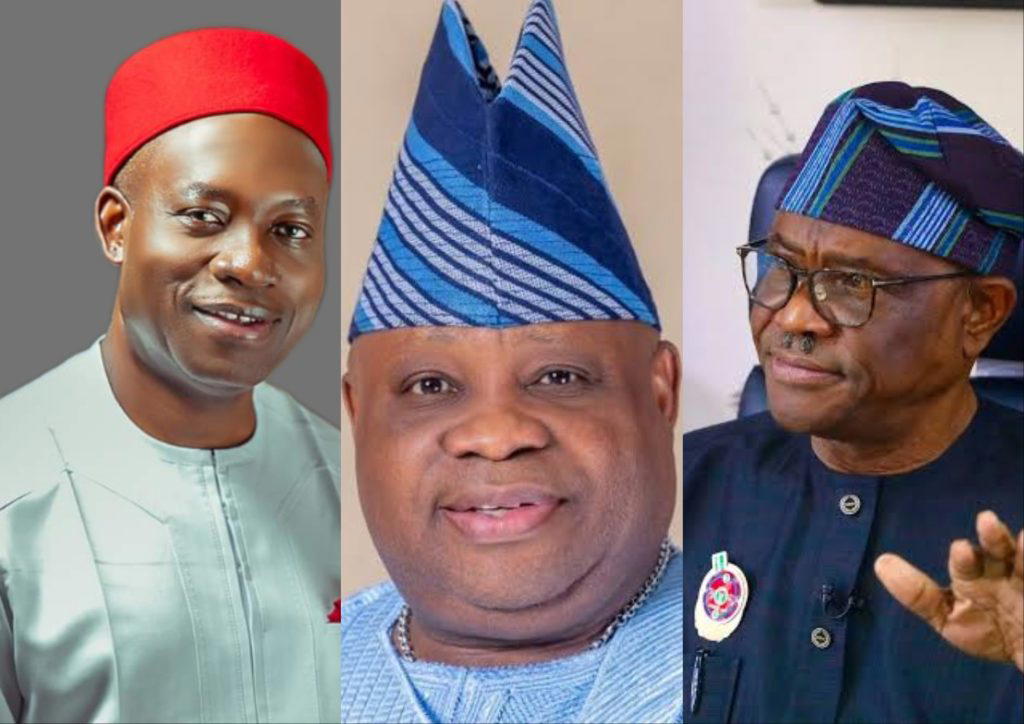
The decision by several opposition governors to support President Bola Tinubu's re-election campaign has ignited debates surrounding party loyalty and the future of opposition unity in Nigeria. Prominent figures such as Nyesom Wike, Chukwuma Soludo, and Ademola Adeleke, represent a crossroads for their respective parties as they navigate their political ambitions amidst a charged electoral atmosphere.
Nyesom Wike, the Minister of the Federal Capital Territory and a leading member of the Peoples Democratic Party (PDP), continues to back Tinubu despite ongoing tensions within the PDP. His support for the ruling party is seen as a move to bolster his political relevance, even as critics within his party accuse him of anti-party actions. Wike's position highlights the challenges faced by the PDP, which is struggling to maintain cohesion as internal rifts deepen.
Similarly, Anambra State Governor Chukwuma Soludo is confronted with the delicate balance of supporting Tinubu while remaining committed to the All Progressives Grand Alliance (APGA). His alignment with the President raises questions about APGA's identity and electoral strategy, as the party seeks to assert its influence in the face of competing interests. Soludo's actions underscore the complexities of political survival in a landscape dominated by larger parties.
Osun State Governor Ademola Adeleke, representing the Accord Party, also finds himself in a precarious situation as he navigates his political choices. His involvement in Tinubu's campaign has sparked discussions about the implications for the Accord Party's future and its ability to present a unified front in the upcoming elections. The overlap of these governors' political strategies has drawn scrutiny from civil society organizations, which have criticized their decisions as detrimental to party integrity.
“The actions of these governors could either strengthen their political positions or lead to significant backlash from their party members,” noted a political analyst. “As the 2027 elections approach, the need for a cohesive opposition has never been more critical.”
As the political landscape evolves, the decisions of Wike, Soludo, and Adeleke will likely impact not only their parties but also the broader dynamics of Nigerian politics heading into the next general elections.
Share this article with your network
Broadcast directly to WhatsApp communities and news circles.
The Abuja Morning Dispatch
Get the capital's most important political investigations, cabinet decisions, and economic intelligence delivered to your inbox every morning.
About The Abuja Times
Super Admin & Lead Director
Related Dispatches in News

NCDC Reports Negative Ebola Tests for Suspected Cases in North-East Nigeria
The Nigeria Centre for Disease Control and Prevention has confirmed that two individuals suspected of having Ebola in the North-east have tested negative. The cases involved a 34-year-old pilot and his wife, alleviating concerns in the region.

More than 5,000 die from Ebola in DR Congo's deadliest outbreak
Government data shows that more than 10,000 people have contracted the rare virus.

Political Tensions Rise in Sokoto Amidst Conflicting Relief Terms and Security Concerns
The African Democratic Congress (ADC) has issued a 24-hour ultimatum to Sokoto security forces following an alleged attack on its governorship candidate, while Ekiti police have made 11 arrests linked to recent political unrest. Additionally, conflicting reports on the government's ₦50,000 relief scheme have sparked confusion as political figures prepare for the upcoming elections.